
When people ask about sativa vs indica vs hybrid, the short answer is that those are plant categories, and shoppers loosely tie them to uplifting, mellow, and mixed experiences. The catch is that almost every strain on a Massachusetts adult-use menu today is technically a hybrid, bred from both lineages over decades of crossing. A jar labeled sativa is usually a hybrid that leans one way, and the same goes for the indica side of the case.
Treat the label as a starting point, not a promise. Two adults can try the same eighth and walk away describing it differently, which is why budtenders in Newton and Natick tend to ask about terpenes and cannabinoid numbers before they ask about the category. Anyone shopping here needs a valid government ID showing they are 21 or older, and the rules around what can be sold and purchased are set by the Massachusetts Cannabis Control Commission.
Table of Contents
Where the Indica and Sativa Labels Came From
Carl Linnaeus named Cannabis sativa in 1753, and Jean-Baptiste Lamarck described Cannabis indica in 1785 after examining plants collected in India. Both men were sorting stems, leaves and seeds, plus the region the plant came from. Neither was recording how anyone felt after using it.
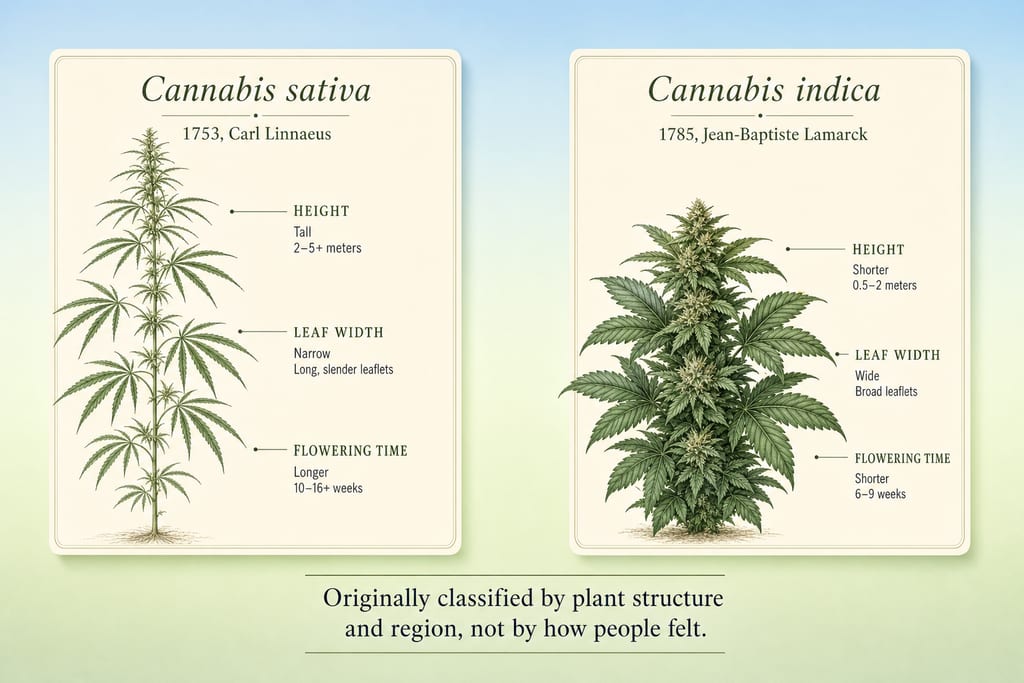
Cultivators kept the two names because those physical traits matter in a grow room. Ceiling height, leaf width and the number of weeks to flower all shape how a harvest gets planned, so the shorthand stayed useful on the production side.
| Category | Plant height | Leaf shape | Flowering time | Typical origin |
|---|---|---|---|---|
| Sativa | Tall, 8 feet or more | Narrow, thin fingers | 10 to 14 weeks | Equatorial Asia, Africa, Central America |
| Indica | Short and bushy | Broad, wide fingers | 7 to 9 weeks | Hindu Kush region, Afghanistan |
| Hybrid | Mid-range, breeder dependent | Mixed leaf width | 8 to 11 weeks | Modern breeding programs |
Breeders in the 1970s and 1980s crossed those lines on purpose, so genetics now get tracked on a seed bank’s pedigree sheet instead of by the shape of the plant. The old split stuck on shelf tags because two words scan faster than a lineage chart, as cannabis type guides point out. Knowing what the words originally described keeps your expectations in the right place when you read a menu.
Sativa vs Indica vs Hybrid Effects Compared
Shoppers describe sativa-leaning strains as heady, chatty and daytime-friendly, and indica-leaning ones as heavy-bodied and slow. Hybrids land anywhere between those two reputations.
| Category | Commonly described feel | When shoppers reach for it | Typical menu wording |
|---|---|---|---|
| Sativa-leaning | Heady, social, talkative | Morning and afternoon | Sativa or sativa-dominant |
| Indica-leaning | Heavy-bodied, slow, couch-friendly | Evening, after work | Indica or indica-dominant |
| Hybrid | Mixed, leans either way | Any time, depends on lineage | Balanced hybrid, 60/40 splits |
Those descriptions come from what consumers report back, and none of them are guaranteed outcomes. Two adults can smoke the same cultivar and describe it in completely opposite words, which is normal.
Menu tags are written by the brand that grew the batch, not by a testing lab, so the wording is marketing shorthand more than a measurement. Popular strain-type explainers make the same point. Ask a budtender how that specific batch has been described by people who tried it.
Sativa Bud vs Indica Bud Up Close
The flower itself does look different between the two classic types, at least some of the time. Growers see it in the jar before anyone sees it on a tag.
- Sativa-type buds: longer, looser, wispier, with thin orange hairs
- Indica-type buds: tighter, rounder, denser, chunky structure
- Hybrid buds: can copy either parent, sometimes both
- Trichome coverage: frosty, sugary, or dull to the eye
- Aroma off the top of the jar: citrus, fuel, pine, pepper, cream
Structure comes from genetics plus how the plant was grown, dried and cured. A dense, chunky nug tells you about the grow, not about how the flower will feel.
Smell gives you better information than shape does, because aroma points straight at the terpene profile. Staff at the Newton and Natick counters can walk you through a jar’s structure, its nose and its lab-tested cannabinoid numbers before you commit to an eighth.
Why Terpenes Beat the Label Every Time
Terpenes are the aroma compounds that give each cultivar its own nose. They are printed on many Massachusetts lab reports, and they are the detail experienced buyers track instead of the category word.
Two jars both tagged indica can carry totally different terpene profiles and read differently to the same person. That is why the terpene list is more specific than the category tag on the shelf.
- Limonene: bright citrus peel
- Myrcene: earthy, herbal, ripe fruit
- Pinene: fresh pine needle
- Caryophyllene: black pepper, spice
- Linalool: floral, lavender-like
THC and CBD percentages are a separate measurement. They describe how much of each cannabinoid the batch tested at, not whether the plant is sativa or indica, and a high number does not mean a better match for you.
Sorting by effect description, cannabinoid content or terpene profile is exactly the conversation Redi budtenders have at both stores, so bring the name of a terpene you liked last time.
How to Pick Your First Jar Without Guessing
Start with the occasion rather than the category word. Telling a budtender “a Saturday afternoon with friends” or “quiet night at home” gives them more to work with than “something sativa.”
- Bring a valid government ID showing you are 21 or older
- Browse the online menu before you drive over
- Read the category tag, then read the terpene list under it
- Ask staff what the batch smells like and how it tested
- Write down what you bought and what you thought
Keep those notes in your phone, or leave them as item reviews in the Redi App when you order ahead for pickup at Newton or Natick, where walk-in shoppers need no reservation.
Try one format at a time, flower one week, a vape cart the next, so you can actually tell what worked. If you have a question about what adults can legally buy or carry in Massachusetts, ask staff at the counter and read the current state regulations yourself.
Shop by the Tag or Shop by the Lab Data
Pure landrace genetics are close to extinct on retail shelves, because breeders have been crossing lines for about fifty years straight. Seed choices get made around yield, flowering time, aroma and how the cured bud looks in a jar, and all four of those targets pull toward mixed lineage.
Menus adjusted by stacking sativa-dominant and indica-dominant tags onto a catalog that is hybrid nearly top to bottom, a shift that strain-category explainers have tracked for years. That leaves you three real ways to work a menu, and each one costs you something.
| Approach | Time it costs | Right for | Trade-off |
|---|---|---|---|
| Category tag only | Under a minute | Deal hunting, restocking a favorite | Batch may read nothing like the tag |
| Terpene and cannabinoid data | Five to ten minutes | Repeat buyers tracking past jars | Useless without notes from last time |
| Ask at the counter | Two or three minutes | First visits, unfamiliar formats | Busy hours mean shorter conversations |
The workable move is to use the tag as a filter, cutting a sixty-item menu down to a handful, then let the aroma and the lab numbers pick the winner. That adds a few minutes to the trip and spares you an eighth you never finish.
Tell a Budtender What Your Night Looks Like
Skip the category label on your next trip and lead with the plan instead. Say “friends coming over around eight” or “first time trying a cart,” and the person behind the counter can cut the case down to three or four jars using effect notes, cannabinoid numbers and the terpene list on the batch. Redi Newton at 24 Elliot St and Redi Natick at 321 Speen St are both open Monday through Saturday, 9AM to 9PM, so build your cart on the menu and grab it at pickup, or walk the case in person with your ID in hand. Locally owned, two stores, and staff who would rather ask questions than hand you a tag.
Sativa, Indica and Hybrid Questions
Do edibles and vapes use the same sativa, indica, and hybrid labels as flower?
Yes, most of them carry the same three tags, but the tag is doing less work on a processed product. A cart or gummy starts as extracted oil, and the brand decides what to add back in and what the final tag says. Check the terpene list printed on the package or the lab report instead, and ask staff what that specific batch tested at.
If I buy the same strain name twice, will it be identical both times?
No. Strain names are not regulated like trademarks, so two growers can sell the same name from different genetics. Even one farm’s own batches shift with the room, the cure and the harvest date. Compare the lab numbers and the terpene breakdown on each jar before assuming your repeat buy will read the same as last time.
Are sativa strains priced differently than indica strains on a dispensary menu?
Not because of the category. Price tracks the grower, the harvest size, the format and whatever promotions are running that day, not whether a jar is tagged sativa or indica. Redi posts daily offers and featured brands on the menu, so sort by price first, then read the terpene list on whatever lands in your budget range.
What should I do if a strain didn’t feel anything like its label said?
Write down the brand, the batch and the terpenes that were on it, then bring that note to the counter next time. A budtender can steer you away from that aroma profile and toward a different one. Sorting by what you actually liked or disliked beats chasing the category word a second time.